Castor oil is a thick vegetable oil extracted from the seeds of the castor plant (Ricinus communis), which is exceptionally rich in ricinoleic acid. It is this unique composition that makes it one of the most widely used oils in the world for hair, beards and nails: it coats the hair shaft, nourishes it deeply and reduces breakage. We explain what it really does, what’s just a myth, and how to use it properly.
What castor oil really does
Its ricinoleic acid gives it three very real benefits:
- It coats and protects the hair fibre : the hair is enveloped in a protective film that reduces breakage and split ends;
- It provides intense nourishment : ideal for dry, frizzy hair and coarse, itchy beards;
- It adds shine : visible results from the very first applications.
Does it really make hair and beards grow?
Let’s be honest: there are no solid scientific studies to show that castor oil accelerates growth. What it does, however – and that’s already a lot – is this: by minimising breakage and keeping the hair nourished, it allows your hair and beard to reach their maximum length without breaking along the way. The result you’ll notice: a longer, denser, healthier mane.
The potion that makes hair and beards grow before your very eyes does indeed exist, but only in *Tintin in the Land of Black Gold*: just ask the Thompsons, who spend half the comic shaving each other’s heads. In your bathroom, you’re better off relying on patience and consistency.
The finer details matter, and we’d rather tell you about them.
Why hair can’t grow any faster: the hair growth cycle
If no oil speeds up growth, there’s a reason – and it’s biological. Every hair follows a three-stage cycle. The anagen phase is when it grows: this lasts between two and five years depending on the individual, and its duration is largely determined by your genes. Next comes the catagen phase, a two- to three-week pause during which nothing happens. Then comes the telogen phase, at the end of which the hair falls out and makes way for the next one.
In other words, the speed of growth and the maximum length your beard can reach are determined by the duration of your anagen phase, not by what you apply to it. This also explains why a beard stops growing at a certain point: it isn’t stunted; it has reached the end of its cycle. Where a grooming product really makes a difference is by preventing the hair from breaking before the end of its growth cycle.
What about massage, then?
It may well be the action itself that matters more than the bottle. Massaging the skin whilst applying the product stimulates microcirculation and improves the supply of nutrients to the hair bulb. The effect is modest and difficult to measure, but it has the advantage of being free and not relying on any particular oil. If you were to take just one thing away from this, it would be this: take an extra thirty seconds to massage.
The alternatives people talk about, and what they’re worth
Two approaches crop up regularly. Peppermint essential oil was the subject of a 2014 Korean study which showed an effect on hair growth, but only in mice, and this has never been confirmed in humans. Sandalwood is being studied for its effect on follicle receptors, though the research is still at a preliminary stage. In both cases, we’re talking about encouraging signs in the laboratory, not proven results in the bathroom. We’d rather tell you this than make empty promises.
How to use it (hair, beard, eyelashes)
As an oil treatment for hair
Apply to the lengths and ends, leave on for 30 minutes to overnight, then shampoo. Once or twice a week is sufficient. Tip: in its pure form, it is very thick: mix it with a lighter oil to make it easier to apply.
On the beard
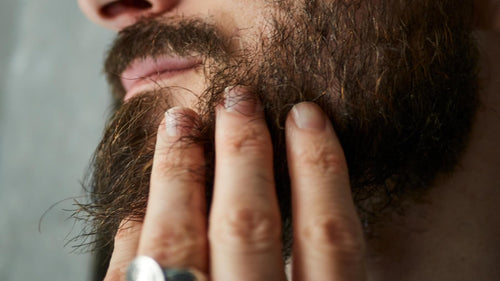
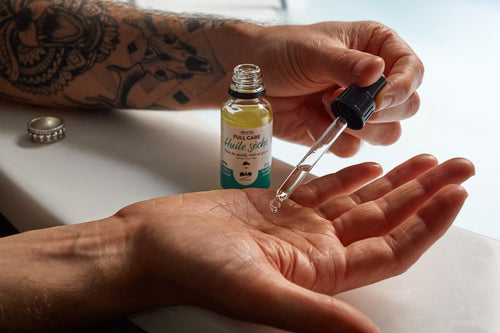
Warm a few drops between your palms and massage into the skin, applying to a clean, slightly damp beard. It softens coarse hair and soothes the sensation of a scratchy beard.
On eyelashes and eyebrows
It can be used, but sparingly and without coming into contact with the eye: just a tiny bit on a cotton bud in the evening, no more.
On nails and the face
It works wonders on cuticles and brittle nails: massage in one drop in the evening. On the face, use with caution: it is a rich oil, moderately comedogenic, best suited to dry skin and best avoided on blemish-prone skin.
And what about the trend of ‘castor oil on the tummy every evening’ seen on social media? No studies have demonstrated any effect from applying it this way: the skin on the tummy does not absorb the oil into the organs, and nothing is eliminated through the navel. Massage it in if the ritual helps you relax, but don’t expect anything more from it.
The alternative without the drawbacks: dry oil
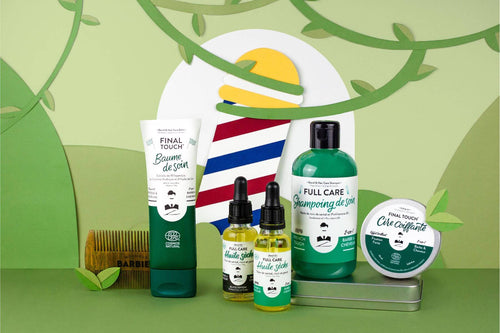
The main drawback of pure castor oil is its texture: thick, sticky and slow to absorb. That’s exactly why we’ve formulated our FULL CARE dry oil for beard and hair: castor oil is combined with sandalwood and poppy in an Ecocert COSMOS ORGANIC-certified formula that nourishes the hair without leaving it sticky or greasy. The effectiveness of castor oil, plus a flawless finish. It perfectly complements the FULL CARE shampoo for a complete routine.
If you’re still unsure about the different textures and don’t know which one suits your beard, we’ve broken down the options by profile – stubble, coarse beard or tight skin – in our guide on which beard oil to choose.
Why is it said to be ‘banned from sale’?
This is a question that comes up time and again, and the answer deserves to be clear. Castor seeds contain a powerful toxin, ricin. However, the oil obtained through cold-pressing does not contain it: ricin is water-soluble and remains in the press residue, never in the oil.
Cosmetic castor oil is therefore perfectly legal and safe for external use. What is regulated is ingestion and certain pharmaceutical uses. The rumour of a ban stems from this confusion between the seed, which is toxic, and the oil, which is not.
Precautions and common sense
- For external use only: castor oil must not be swallowed (its traditional laxative uses are the preserve of healthcare professionals, not the bathroom);
- Carry out a patch test on the inside of your elbow 24 hours before first use;
- Choose virgin, cold-pressed and organic castor oil: this guarantees an unrefined oil that has retained its active ingredients.
And if your beard is simply not going to grow? There’s always the Bruce Willis option: a clean-shaven head, worn with confidence and maintained with a safety razor. No one has ever accused John McClane of lacking charisma.
FAQ
How long before I see results?
Allow 3 to 4 weeks of regular use to feel your hair become softer and less brittle, and 2 to 3 months for a visible effect on hair length retention.
Can it be used every day?
On your beard, yes, in small amounts. As a hair mask, once or twice a week is enough: any more than that and you’ll overload the hair fibre without any additional benefit.
Is it suitable for oily hair?
On the lengths, yes, but avoid the roots: opt for a dry texture that doesn’t weigh the hair down.
Black (Jamaican) or standard castor oil?
The black variety is made from roasted seeds: it’s higher in ash content and is renowned for use on very thick hair. For beards and European hair, classic cold-pressed virgin oil does the job perfectly.
Does it have healing properties (cysts, eczema, burns)?
Not proven: it is a cosmetic, not a healthcare product, and none of these uses have been scientifically validated. For any skin condition, the best course of action is to consult a healthcare professional, not rely on a bottle of oil.
Des conseils de barbier honnêtes, sans poudre aux yeux. Ce que la science ne prouve pas, on vous le dit aussi.
Notre démarche →